
News sites
Years of experience
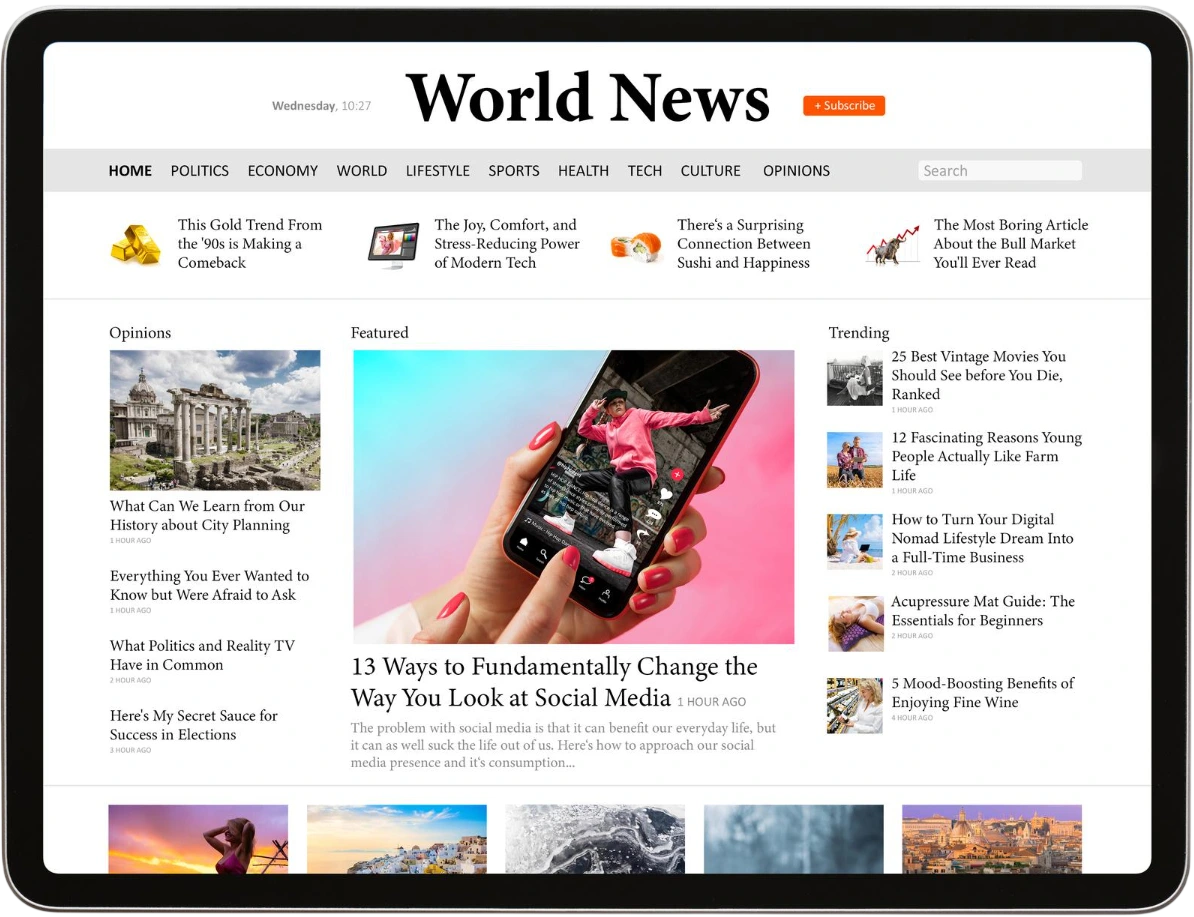
A news portal is far more than a website with an article feed. It is a complex information system that must handle thousands of simultaneous visitors, publish content in real time, rank well in search engines from day one, and generate revenue from the first month of operation.
A news website (online publication, news portal, internet media outlet) is a multi-page web resource focused on the regular publication of current content: articles, reports, video materials, photo essays, analysis and expert commentary. Unlike a corporate website or e-commerce store, a news portal lives and dies by the constant flow of information — its content is updated daily or even hourly.
There is no universal template for a “news website.” Before development begins, it is critical to define exactly what type of resource you are building — this determines the architecture, feature set, technology stack, and budget.
Covers events in a specific city or region: municipal politics, local business, cultural events, city services, crime and emergencies. The audience consists of local residents, city administrations, and regional advertisers. The defining characteristic is geolocated traffic and high audience engagement — people read about what matters in their immediate environment.
Technical priorities: fast loading on mobile, events calendar section, maps integration, classifieds module, neighborhood-level news categories.
Focuses on a single vertical: technology, finance, sports, health, fashion, automotive, real estate, agriculture, and so on. These portals are easier to monetize through native advertising and affiliate programs because the audience is homogeneous and highly valuable to industry-specific advertisers.
Technical priorities: deep category taxonomy, tag systems, topic-based search, SEO targeting informational queries, integration with industry sources via RSS feeds.
A large-scale portal covering politics, economics, society, and international news. Requires maximum technical reliability, live streaming support, and a complex editorial structure with separate author and editor roles and permissions.
Technical priorities: multi-author system with granular permissions, article versioning, video hosting integration, push notifications, RSS feeds, XML sitemap for Google News.
An internal company resource or the brand's public media presence. Publishes corporate news, press releases, case studies, and industry analysis. The primary goal is building expert reputation and improving the main corporate website's SEO through authoritative content.
Technical priorities: visual consistency with the corporate site, CRM and email marketing integration, draft access control and approval workflows.
Automatically collects content from third-party sources via RSS, API, or web scraping. Requires no editorial team, but demands sophisticated technical implementation: duplicate filtering, format normalization, and source blacklisting.
Technical priorities: Elasticsearch for fast search across large content volumes, content deduplication, automated categorization via NLP, aggressive caching.
Operates across multiple language markets simultaneously. Requires correct hreflang implementation, separate editorial teams for each language, localized interfaces, multi-currency monetization, and CDN distribution with nodes in target regions.
Technical priorities: WordPress Multisite or custom multilingual architecture, full WPML or Polylang integration, separate XML Sitemaps for each language version.
News website development at WildWeb Studio follows a structured, transparent process. Every stage is documented, and the client has real-time access to progress.
Stage 1
Before writing a single line of code, we conduct a thorough analysis:
Stage 2
Stage 3
We develop a unique visual identity that matches the publication’s positioning. News design is not just aesthetics — it is readability, headline hierarchy, and contrast suited for consuming large volumes of text. We build a design system with reusable components that can scale as new categories are added.
Stage 4
This is where the Figma designs become a functioning website. We work with proven technology stacks:
Stage 5
SEO is built into the site architecture from day one, not bolted on afterward. We configure:
Stage 6
We connect all necessary third-party services:
Stage 7
Stage 8
A news website is one of the most heavily loaded categories of web resources. A single viral publication can deliver 100,000+ page views within a few hours. Without the right architecture, the site will go down exactly when you need it most — when the traffic spike happens.
We implement multi-layer caching:
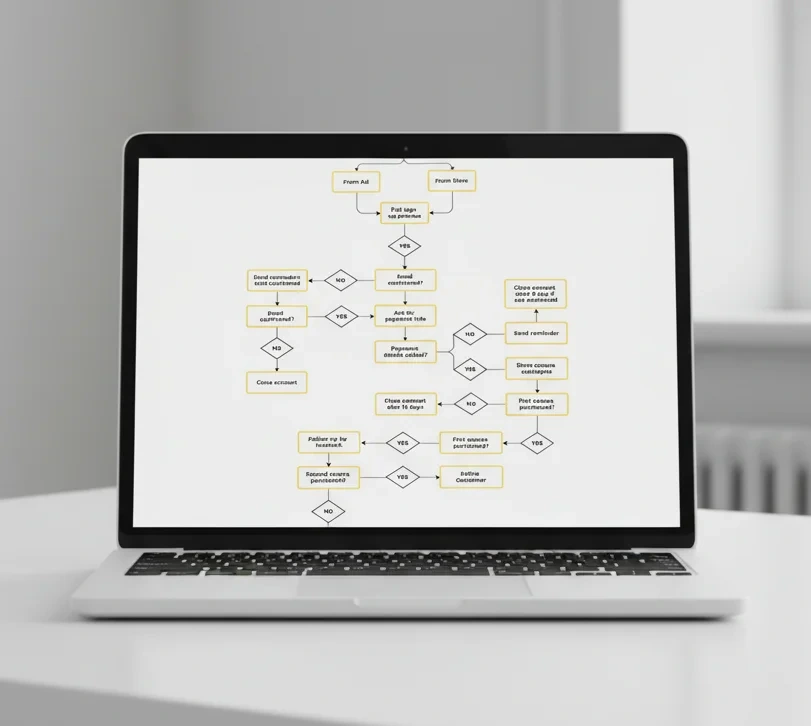
Google actively evaluates news websites against E-E-A-T criteria (Experience, Expertise, Authoritativeness, Trustworthiness). This is especially important for “Your Money or Your Life” topics — health, finance, law, and politics. Building trust requires:

Building a news website is an investment that should generate a return. Here is the full map of monetization strategies available:
The price of building a news portal depends on complexity, required features, and the technology stack. We offer three core packages that cover the majority of needs:
| Parameter | START Package from $500 |
MEDIA Package from $1 000 |
FLAGSHIP Package from $1 500+ |
|---|---|---|---|
| Platform | WordPress + ready-made theme | WordPress + custom design | Custom development (Laravel / Next.js) |
| Design | Theme customization | Unique UX/UI design | Full design system |
| Categories | Up to 10 | Up to 30 | Unlimited |
| Multilingual | — | 2 languages | 3+ languages |
| SEO setup | Basic | Advanced + Schema.org | Full + Google News |
| CDN | — | Cloudflare Free | Paid CDN |
| Load testing | — | Basic | Full (up to 50k users) |
| Monetization | AdSense | AdSense + direct ads | All formats + paywall |
| Support | 1 month | 3 months | 6 months |
| Timeline | 4–6 weeks | 6–10 weeks | 10–16 weeks |
Included in every package: first-month hosting, domain registration, SSL certificate, basic SEO configuration, CMS training, and video tutorials for the editorial team.
Exact timelines depend on project complexity and the speed of client approvals. Average ranges:
WordPress with a premium theme and basic functionality
Custom design + WordPress
Custom development (Laravel, Next.js)
Multilingual portal with custom architecture
The single biggest cause of delays is slow approval cycles on the client side. We work in two-week sprints — every two weeks you see a working version and provide feedback. This is significantly faster than the traditional “waterfall” approach where you see nothing for months and then get everything at once.
Google News is a separate Google product that aggregates content exclusively from verified publishers. Acceptance requires manual review by a Google team. Here is the complete checklist for successful verification:
AI Overview is the AI-generated answer block that appears at the top of Google search results for many informational and news-related queries. For news topics, it is built from fresh, authoritative content. To get your content featured:
Experience since 2012.
We have navigated every major Google algorithm update and understand what drives sustainable, long-term rankings for news publications.
End-to-end approach.
We do not just "build a website" — we construct a media business from the ground up: strategy, design, engineering, SEO, and monetization.
Full transparency.
You see working progress every two weeks. No black box that delivers a finished product three months later.
Deep knowledge of the Ukrainian and Eastern European market.
We understand local advertiser ecosystems, Ukrainian audience behavior, and the technical requirements for UA/RU/EN multilingual sites.
Right technology for the right project.
WordPress, Headless CMS, Laravel, Next.js, Redis, Elasticsearch — we choose the stack that fits your specific needs, not the one that is easiest for us to build.
Post-launch support.
We do not disappear after handoff. The first 1–6 months after launch are the most critical period, and we are available throughout.
News portals are updated daily with new articles, links, and other "fresh" content. To ensure that this content reaches users on time, developers often resort to CDNs;
The main feature of this type of portal is its territorial affiliation. In fact, one resource collects all the information of a city: posters, news, a catalog of organizations, and announcements;
This type of portal contains enormous amounts of information, both from third-party resources and internal databases. Such portals must be able to withstand a heavy load from simultaneous visits by thousands of Internet users and have advanced search functions.
Official websites are one of the most visited types of portals. Therefore, when developing the backend, several servers are usually involved. The functionality of such web resources includes news, useful information for citizens, and an application form;
The purpose of creating a corporate portal is to provide employees with access to the company's corporate data. These are highly customized portals that contain all the necessary tools for collaboration (chats, file sharing, etc.);
This type of development is implemented individually for the type of project. Unique online portals specifically for your tasks. The possibility of adding various modules is unlimited.
As a rule, website development implies the creation of an administrative panel with the separation of roles, support for receiving notifications, and additional features to speed up the work of managers (for example, such as templates of frequently used blocks, multifunctional visual editors, etc.)
For a steady increase in traffic, it is important to provide an opportunity to receive updates on a daily basis: RSS feed, email newsletter, reposting content on social networks, browser notifications, etc.
A web resource should be designed taking into account the expected traffic, as it is very easy to lose an audience in this niche. It will help you:
Correct construction of the architecture, taking into account scalability and future load; For search, it is advisable to use search engines such as Elasticsearch or Sphinx; A mandatory stage of project delivery should be load testing; Use servers with automatic scaling (AWS, Microsoft Azure);
Technically yes. Wix, Squarespace, and Tilda allow building a simple blog with a news section. But website builders cannot handle traffic spikes (a viral story will take the site offline), do not support proper Google News SEO configuration, cannot accommodate custom monetization models, and do not scale. If the goal is a serious media outlet rather than a hobby blog, professional development is required.
WordPress holds approximately 60% of the news website market — for good reason. It is a mature platform with a vast plugin ecosystem, familiar to editors, and technically well-optimized. For large projects with unique requirements, we use Headless WordPress + Next.js or custom Laravel solutions. Drupal is a solid choice for government portals. Joomla is outdated and we do not recommend it for new projects.
Since 2021, Google removed AMP as a requirement for inclusion in Top Stories and Google News. Good Core Web Vitals on standard pages are sufficient. We recommend investing in the performance of the main site rather than maintaining a separate AMP format that adds complexity without meaningful benefit.
A new site typically begins receiving meaningful organic traffic 3–6 months after launch, assuming consistent daily content publication. Faster results come from Google News inclusion: once accepted, News traffic arrives within days of verification. Social media and email newsletters generate traffic from the very first publication.
Basic technical maintenance (plugin updates, backups, security monitoring) costs $50–100/month. Active SEO work, content production, or ongoing feature development are priced separately. Our packages include free support for 1–6 months depending on the tier.
Yes. News site migrations require meticulous planning: all URLs must be preserved or properly redirected, metadata must be maintained, and historical search traffic must be protected. We have migrated sites with hundreds of thousands of articles with no rankings loss. Migration cost is calculated individually based on volume and complexity.
In Ukraine, registering a website as an official media outlet is not mandatory, but it provides advantages: legal editorial status, the ability to obtain press credentials for journalists, and added credibility with advertisers. We can refer you to media law specialists for guidance.
Contact us through any convenient channel: