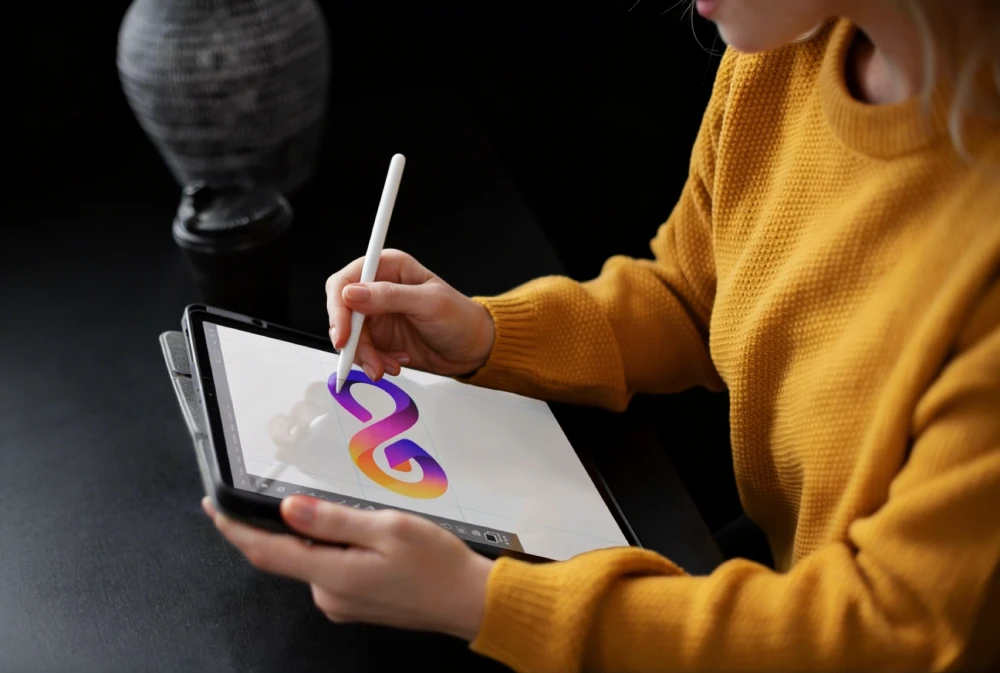
Professional Logo Design Services

Website Development with WildWeb Studio

A customized logo helps to stand out among competitors and creates a unique identity that makes the brand easily recognizable.

A logo is not just a visual element — it is the strategic core of your brand identity. Research by Nielsen Norman Group shows that users form an opinion about a brand in just 50 milliseconds, and Harvard Business Review confirms that companies with consistent visual identity generate 33% more revenue than those without. At WildWeb Studio, we have been creating logos since 2012 that do more than look good — they work strategically for your business, attract the right audience, communicate your values, and convert first impressions into lasting trust.

This comprehensive guide covers everything you need to know about professional logo design: the creative process, pricing factors, file formats, the difference between a logo and a brand identity system, common mistakes to avoid, and answers to every question businesses ask when commissioning a logo.

What Is a Logo and Why Is It Critical for Your Business?

A logo is a unique graphic mark, symbol, or combination of text and imagery that identifies a company, product, or service. But behind this simple definition lies a powerful strategic tool. According to a University of Loyola study, color alone increases brand recognition by 80%. Forbes reports that 77% of consumers make purchases based on brand perception rather than product specifications alone.

A professionally designed logo simultaneously serves seven key functions: it differentiates your company from competitors; builds the first emotional trust with potential customers; communicates your values and positioning; ensures recognition across all touchpoints from website to packaging; becomes a legally protected asset once trademark-registered; increases the perceived value of your products or services; and serves as the foundation for your entire brand identity system.

Types of Logos: Which One Is Right for Your Business?

There are seven primary logo types, and choosing the right one is already a strategic branding decision.

Type 1:

Wordmark (logotype-word)

stylized writing of the brand name (Coca-Cola, Google).

Type 2:

Lettermark (monogram)

abbreviation of the brand name. Examples: IBM, NASA, HBO. Suitable for companies with long names.

Type 3:

Brandmark (symbol)

pure graphic symbol without text (Apple, Nike, Twitter). Requires time to build recognition.

Type 4:

Combination mark

text and symbol together, the most versatile type (Adidas, Burger King, Lacoste).

Type 5:

Emblem

text inside a symbol or shape. Examples: Starbucks, Harley-Davidson. Classic, authoritative style.

Type 6:

Mascot

illustrated character representing the brand. Examples: KFC, Michelin. Great for consumer brands.

Type 7:

Abstract mark

geometric or abstract shape. Examples: Pepsi, Mastercard. Gives complete freedom from associations.

Our Logo Design Process: 7 Clear Steps to Your Perfect Logo

Our process is not ‘design and deliver.’ It is a strategic, step-by-step approach where every stage has a specific purpose and measurable outcome.

Step 1: Brief and Discovery Session

Everything begins with a deep dive into your business. We conduct a structured session — online or in-person — to clarify your company’s mission, target audience, desired emotional response, competitive landscape, and visual preferences through reference gathering. The output is a clear creative brief that becomes the roadmap for the entire team.

Step 2: Market Research and Competitive Analysis

Before picking up a pencil, we research your market: analyzing competitor logos, studying visual trends in your industry, and examining the cultural and psychological significance of colors, shapes, and typographic choices for your specific target audience. Result: we know what already exists in the market and can confidently create something genuinely distinctive.

Step 3: Ideation and Sketch Development

Our designers generate 20 to 50 initial hand-drawn sketches. This is ‘brainstorming on paper’ — rapid and unconstrained, exploring unexpected directions. From this body of ideas, the 3 to 5 strongest concepts are selected for digital development.

Step 4: Digital Concept Development

Selected ideas are developed in Adobe Illustrator or Figma. Each concept is refined in detail: proportions, visual balance, legibility at different scales. We test every logo on realistic mockups — website headers, business cards, branded merchandise, and signage — to ensure it works in real-world applications.

Step 5: Concept Presentation and Feedback

You receive 2 to 5 concepts (depending on your package) in a structured presentation. Each concept is accompanied by a rationale explaining the design decisions: why this form, why this color palette, why this typography. Your feedback is valuable creative material for the next step.

Step 6: Refinement and Finalization

Based on your feedback, we refine details, test on dark and light backgrounds, verify legibility at 16 pixels (favicon size) and at large format, and run a similarity check to confirm uniqueness in the market.

Step 7: Final File Delivery and Rights Transfer

You receive a complete package of final files accompanied by a signed contract transferring full intellectual property rights. No hidden fees. No usage restrictions. Your logo — forever.

What File Formats Are Included?

  • SVG (Scalable Vector Graphics) — infinitely scalable, perfect for websites and email marketing
  • AI or EPS — the native Adobe Illustrator source file for printers, agencies, and future editing
  • PDF — print-ready vector format, opens universally
  • PNG with transparent background — for social media, presentations, websites
  • JPG — for backgrounds where transparency is not required
  • Favicon (ICO/SVG) — miniature version for browser tabs and mobile app icons
  • Light and dark background variants — for correct display in every context
  • Monochrome version — for embossing, embroidery, and single-color print applications

Logo Design Pricing: A Transparent Breakdown

Logo design pricing is nuanced and depends on multiple factors. Here is what actually drives the cost:

Factors Affecting Price

  • Concept complexity: a simple wordmark costs less than a detailed mascot or complex combination mark
  • Research depth: basic brief vs. full competitive analysis with positioning strategy
  • Number of concepts: 1 direction vs. 5 independent creative approaches
  • Revision rounds: 1 round vs. unlimited revisions
  • Additional deliverables: logo only vs. brand guidelines, style guide, or full brand book
  • Studio experience: the portfolio and expertise you are purchasing
  • Urgency: standard timeline vs. accelerated delivery
  • Language versions: single-language vs. multilingual logo adaptations

WildWeb Studio pricing for 2025:

Start — from $150

  • Timeline: 3–5 days
  • 1 concept
  • Vector file
  • PNG file

Business — from $350

  • Timeline: 7–10 days
  • 3 concepts
  • Guideline

Premium — from $700

  • Timeline: 14–21 days
  • 5+ concepts
  • Brandbook

Corporate — from $1,500

  • Timeline: 21–30 days
  • Strategy
  • Full identity

Why the Cheapest Option Is Usually the Most Expensive in the Long Run

A $20-50 logo from a freelance marketplace sounds appealing. But the real risks are significant: reliance on stock library elements already used in thousands of other brands; no strategic research or audience insight; no proper intellectual property contract; incorrect file formats that cannot be scaled or edited; and a design that looks generic rather than distinctive. Most businesses that go this route pay twice when they need to rebrand within 12 months. A professionally designed logo is a one-time investment that pays dividends for years.

Logo vs. Brand Identity vs. Brand Book: Understanding the Difference

Logo

A single graphic mark — the atom of your brand. Every other branding element is built on top of it. Without a strong logo, it is impossible to create a consistent brand identity system.

Brand Guidelines (Minimum Standard)

A document of 5 to 15 pages specifying the rules for correct logo usage: clear space (exclusion zone), minimum size, approved color variants on different backgrounds, and prohibited uses. Essential for every business that shares the logo with contractors, partners, or vendors.

Visual Identity System

An expanded system: logo + color palette + typography + graphic elements + templates (business cards, letterheads, envelopes, presentations, social media assets). Ensures a unified brand appearance across all customer touchpoints.

Brand Book

The complete brand constitution: mission, vision, values, brand voice, tone of voice guidelines, and detailed standards for every element of the visual identity. A document of 50 to 200+ pages. Critically important for corporate brands, franchises, and companies with large distributed teams.

Color is one of the most powerful tools for communication in a logo. Research by the University of Loyola showed that color increases brand recognition by 80%. But choosing a color is not a matter of personal preference — it’s a strategic decision:

  • Red: energy, passion, urgency, appetite. Used by: Coca-Cola, YouTube, Netflix. Stimulates active actions. Suitable for: restaurants, entertainment, sales.
  • Blue: trust, reliability, intelligence, calm. The most popular color in corporate branding. Used by: Samsung, Facebook, LinkedIn. Suitable for: finance, technology, healthcare.
  • Green: nature, health, growth, eco-friendliness. Used by: Whole Foods, Starbucks, John Deere. Suitable for: organic products, pharmaceuticals, financial services.
  • Yellow/Gold: optimism, warmth, premium feel. Used by: McDonald’s, IKEA, Rolex. Suitable for: youth brands, premium segment.
  • Black: elegance, luxury, power, authority. Used by: Chanel, Apple, Nike. Suitable for: fashion, technology, premium brands.
  • Purple: creativity, wisdom, luxury. Used by: Cadbury, Hallmark, Lay’s. Suitable for: beauty, education, premium products.
  • Orange: friendliness, enthusiasm, accessibility. Used by: Amazon, Harley-Davidson, Fanta. Suitable for: entertainment, sports, retail.

WildWeb Studio selects a color palette based on your audience’s psychological profile, competitor analysis, and brand positioning — so that colors work for you, not against you.

The Psychology of Color in Logo Design

The Most Common Logo Design Mistakes (and How to Avoid Them)

Over 12+ years of work, we’ve seen hundreds of logos that didn’t work. Here are the most common mistakes:

  • Too complex design: a logo must be readable at 16px (favicon). If it’s unclear at a small size, it doesn’t work.
  • Using raster graphics instead of vector: JPG or PNG do not scale — when enlarged, pixels blur.
  • Copying trends: what’s trendy today may look outdated in 2–3 years. Classic designs are always relevant.
  • Too many colors: 2–3 colors is optimal. More than that — chaos.
  • Unreadable font: decorative fonts at small sizes turn into a mess.
  • Lack of clear space: a logo needs “breathing room” — space not occupied by other elements.
  • Logo without a guideline: contractors and partners will use it incorrectly, damaging the brand impression.
  • Buying a logo without a contract: without a written transfer of copyright, the logo legally remains with the designer.

Ordering a logo online – how does it work at WildWeb Studio?

The entire process is done remotely—we work with clients across Ukraine and abroad. Here’s a simple path to your perfect logo:

Step 1

Submit a request on the website or message us — we respond within 2 hours during business hours

Step 2

Free consultation (15–30 minutes) — we clarify your goals and select the suitable package

Step 3

Payment and contract signing — transparent terms, fixed price

Step 4

Detailed brief completion — online form or call

Step 5

Receive concepts within the agreed timeframe

Step 6

We make revisions and finalize

Step 7

Receive all files + copyright transfer agreement

Frequently Asked Questions

The Start package takes 3-5 business days. The Business package takes 7-14 days. A full brand identity system with a brand book takes 3-6 weeks. Rush delivery is available for an additional fee.

Our detailed briefing process significantly reduces this risk. If after all revisions you remain unsatisfied, we will either develop new concepts at an additional fee or provide a refund per the terms of our agreement.

Yes. Upon receiving final files and signing the IP transfer contract, you hold full rights to register your logo as a trademark in Ukraine (UKRPATENT), the European Union (EUIPO), the United States (USPTO), or internationally through WIPO. We can provide guidance on this process.

Absolutely. We have experience working with clients in the USA, Canada, the UK, Poland, Germany, and beyond. Payment is accepted in UAH, USD, and EUR. Communication is available in Ukrainian, Russian, and English.

We run uniqueness checks through specialized tools before delivering the final design. We strongly recommend trademark registration, as it is the only legal mechanism that provides full ownership protection in your territory.

We combine 12+ years of experience, a full strategic process (not just design), a dedicated team (strategist, designer, art director, project manager), transparent pricing with a fixed contract, delivery of all file formats, and a signed intellectual property transfer agreement — all at highly competitive rates thanks to our Ukraine-based operations with international-standard quality.

WildWeb Studio vs. Freelancers vs. AI Logo Generators

Freelancers offer direct contact and flexibility, but depend on a single person’s availability, mood, and breadth of expertise. A studio brings a structured team with defined roles, guaranteed timelines, and legal accountability through a formal contract. AI generators like Turbologo or Canva are excellent for hobby projects but draw from shared template libraries — meaning thousands of other brands may share similar or identical elements. AI-generated logos cannot be trademark-registered, and they provide no strategic positioning analysis.

WildWeb Studio offers the strategic depth and creative quality of top-tier international agencies at a fraction of the cost — a genuine competitive advantage for businesses operating in any market.

Our latest works

Idea: Imitation of a compass and the four cardinal points combined with the first letter of the owner's surname. Request for a clean minimalist design

Logo design for an online clothing store for travel, USA

Website Development with WildWeb Studio

Ready to Create Your Logo? Start Here.

Over 12 years of experience. Hundreds of satisfied clients across Ukraine and internationally. A 30% repeat client rate that speaks to our quality and reliability. Transparent process with a fixed-price contract. Legal IP transfer included. All file formats delivered. Response within 2 business hours.

Visit wildwebstudio.com to submit your project inquiry and receive a free consultation. Let us build the visual foundation your brand deserves.