

Graphic design is one of the highest-ROI investments a business can make. Consider the numbers: humans process images 60,000 times faster than text. 80% of all information is absorbed visually. Companies with strong design grow revenue 33% faster than average (Lucidpress). Adobe research shows design-driven companies outperform the S&P Index by 228%. And Nielsen Norman Group established that users form an opinion about a brand in exactly 50 milliseconds — with visual design as the primary input. At WildWeb Studio, since 2012, we have been creating graphic design that does more than look good — it performs strategically for your business.
This comprehensive guide covers everything about professional graphic design services: all types and specializations, the full process from brief to delivery, file formats and technical specifications, transparent 2026 pricing, current design trends, industry-specific considerations, common mistakes to avoid, and answers to every question businesses ask when commissioning design work.
Graphic design is the discipline of visual communication: combining art, strategy, and technology to create visual solutions that convey ideas, messages, and emotions to a specific audience. It encompasses everything from a business card to a global rebranding campaign, from a social media post to a 300-page annual report, from a product label to an animated brand film.
The business case is unambiguous. Research by the Design Council found that for every £1 invested in design, businesses receive £20 back in revenue. Packaging design research by Ipsos shows that 72% of consumers report that packaging design influences their purchase decision. A study by Canva found that 46% of consumers consider the visual appearance of a brand to be critical in their purchasing decision. Design is not decoration — it is infrastructure.
Animated logos, video graphics, intro/outro sequences, animated social content, GIF creation, and kinetic typography. In 2026, video content receives 1,200% more shares than static content combined. Brands that do not incorporate animation are rapidly losing engagement to those that do. Motion design operates at the intersection of graphic design, storytelling, and time.
Every project begins with thorough project definition. We ask the right questions: What is the purpose of this material? Who is the target audience? Where and how will it be used? What are the technical constraints? What is the timeline and budget? What references resonate with you and why? A well-constructed brief cuts revision rounds in half and ensures the output matches expectations. We provide a structured brief template or conduct a briefing call — whichever works best for your workflow.
Before any creative work begins, we research. We study your audience's visual expectations, analyze competitors' design approaches, identify current trends in your sector, and research the best international practices in relevant design categories. For branding projects, we map the competitive visual landscape to identify differentiation opportunities.
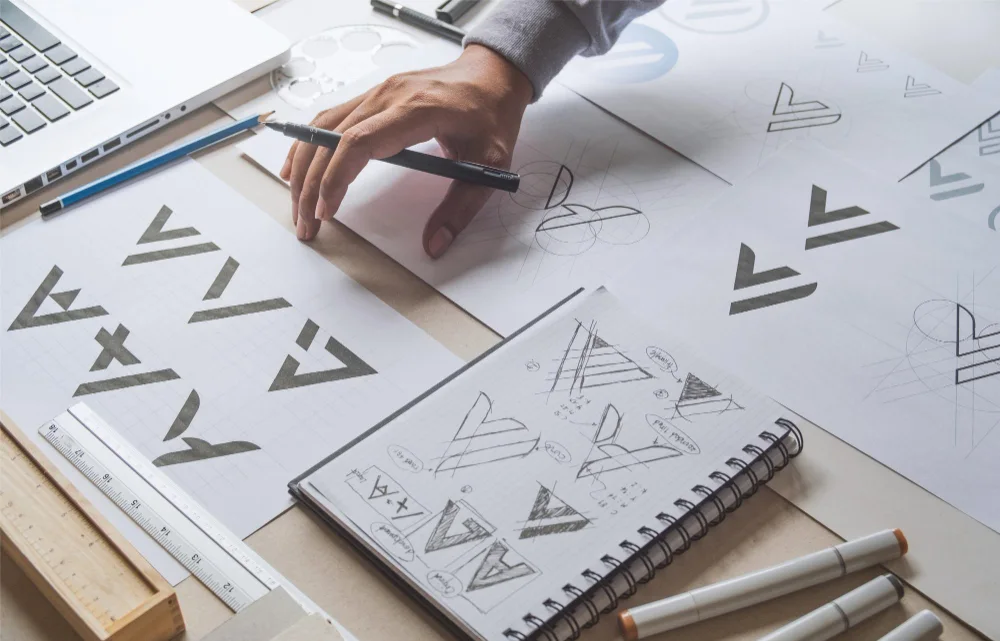
With research completed, we generate ideas. Designers develop 3-10 initial concept sketches (in pencil and digital), exploring different directions without constraint. From this body of ideas, the strongest 2-3 concepts are selected for full development. This rapid ideation phase prevents the first digital concept from automatically becoming the final one.
Selected concepts are developed in the appropriate software: Adobe Illustrator for vector graphics and branding, Photoshop for image manipulation and raster work, InDesign for multi-page publications, Figma for web and interface design. Each concept is refined in detail: proportions, visual balance, typographic hierarchy, color relationships, and readability at multiple scales. Technical correctness is verified at every stage.
You receive the design concepts in a clear, contextualized presentation — shown on realistic mockups relevant to the intended application (business card in-hand, poster on a wall, banner on a website). We explain each design decision: why this color, this typeface, this composition. Your feedback is the creative input for the next phase.
Based on your feedback, we refine the design. Depending on your package, this may include 1-3 structured revision rounds or unlimited revisions. We distinguish between 'revisions' (changes within the approved direction) and 'direction changes' (starting a new creative approach) — and we handle both with professionalism and transparency.
The approved design is prepared in all required formats: print-ready files (PDF/X, CMYK, 300+ dpi, with bleed), digital formats (PNG transparent, JPG, SVG, WebP), and source files for future editing (AI, PSD, INDD, or Figma). Files are organized, labeled, and delivered with a brief explanation of each format's intended use.
Vector graphics (SVG, AI, EPS, PDF) are built from mathematical equations and scale infinitely without any quality loss — from a 5mm business card logo to a 10-meter billboard. They are essential for logos, icons, illustrations, and any element that will appear at multiple sizes. Raster graphics (PNG, JPG, PSD, TIFF) are composed of pixels and have a fixed resolution. Enlarging them beyond their native resolution causes quality degradation (pixelation). They are ideal for photographs, detailed illustrations, and web graphics at a defined size.
There is no single universal price for graphic design — costs vary significantly by service type, complexity, and provider. Below is a realistic comparison across the three main provider categories:
| Service | Start | Middle | Premium |
|---|---|---|---|
| Logo | $50–300 | $150–800 | $800–5,000+ |
| Brand Identity | $200–600 | $500–2,000 | $2,000–20,000+ |
| Brochure | $50–200 | $150–600 | $500–2,000+ |
| Packaging | $80–300 | $200–1,000 | $1,000–5,000+ |
| Banner | $20–80 | $50–200 | $150–500+ |
| Infographic | $50–150 | $100–400 | $300–1,500+ |
| Presentation | $80–250 | $200–800 | $500–5,000+ |
| Illustration | $30–200 | $100–600 | $400–3,000+ |
| SMM Design / Social Media | $10–40/post | $30–150/post | $100–500+/post |
WildWeb Studio provides a detailed fixed-price quote for every project before any work begins. No hidden fees, no scope creep surprises.
The evolution beyond flat design: clean, uncluttered compositions with a sense of physicality through carefully crafted shadows, subtle gradients, and material-inspired textures. Apple, Google, and Linear define this direction. It signals sophistication without complexity.
Oversized, expressive, and unconventional typography moving to the center of compositions — the typeface becoming the image rather than just the carrier of text. This trend originated in fashion and luxury branding and has spread across all sectors.
Midjourney, Adobe Firefly, and DALL-E are transforming the speed of conceptual exploration. They do not replace designers — they dramatically accelerate the ideation phase. The competitive advantage now belongs to designers who can direct AI tools precisely and curate results with strategic judgment.
Nostalgic aesthetics from the 1970s, 1980s, and 1990s — earth tones, acid colors, slab serif and handwritten typography, grain textures, halftone patterns. This trend is driven by the audience desire for authenticity and humanity in an increasingly digital world.
Increasingly accessible 3D tools (Blender, Cinema 4D, Spline) are bringing three-dimensional elements into logos, packaging, and digital assets. Brands using 3D design signal innovation and premium quality.
Modern brand systems are designed as adaptive systems: a minimal version for favicon, a standard version for web, an expanded version for outdoor. The identity adapts to context without losing coherence — the future standard for any brand operating across multiple channels.
Design that considers environmental impact: minimizing ink coverage in print, specifying sustainable materials, designing for recyclability. For brands targeting ESG-conscious consumers and Gen Z audiences, this is not a trend — it is a baseline expectation.

A simple banner or flyer: 1-3 business days. Logo with guidelines: 5-14 days. Brochure or catalog: 7-21 days. Full print campaign or complete branding system: 4-8 weeks or more. Timelines depend on project complexity, number of revision rounds, and speed of client approvals. Rush delivery is available for an additional fee.
Most print materials require a PDF in CMYK color mode at 300+ dpi resolution with 3-5mm bleed and crop marks. Fonts must be embedded or converted to outlines. WildWeb Studio handles all prepress file preparation as a standard part of print projects — you do not need to manage the technical details.
Yes. Every WildWeb Studio project includes delivery of source files in the appropriate format (AI, PSD, INDD, or Figma) in addition to the final production files. Without source files, you are permanently dependent on the original designer for any future changes — a position we believe no client should be in.
Graphic design is a broad discipline covering visual communication across print and digital media. Web design specializes in digital interfaces and user experience. UX design focuses on user behavior and information architecture. Motion design specializes in animation and video. WildWeb Studio has specialists in all of these areas within a single integrated team.
Prepress is the preparation of design files for commercial print production: verifying color modes (RGB to CMYK conversion), resolution, bleed, font embedding, transparency flattening, and overprint settings. Errors in prepress produce defective print runs — wasted materials, wasted money, and wasted time. WildWeb Studio includes prepress verification as a standard component of all print projects.
Yes. Adapting an approved design to additional formats and sizes — A4 to A5, landscape to portrait, print to digital, static to animated — is a standard service and always significantly less expensive than designing each format from scratch.
Russian, and English. Payment is accepted in UAH, USD, and EUR.
Look for: a portfolio with work in your industry or at the complexity level your project requires; a defined process (brief → research → concept → development → revisions → delivery); a formal contract specifying deliverables, timeline, revision rounds, and IP transfer; delivery of source files in addition to final formats; and transparent, fixed pricing. WildWeb Studio meets all of these criteria.
Visit wildwebstudio.com to submit your project inquiry. We respond within 2 business hours with a free consultation and project assessment. Let us create design that works as hard as your business does.